Do You Need an NCDOT Driveway Permit?
If your driveway will connect to a state maintained road, yes. North Carolina General Statute 136-93 bars any opening in a state road without a written permit from NCDOT. NCDOT charges no fee to apply for a driveway permit.
The property owner applies through the local NCDOT District Engineer’s office. On a rural road, the part you notice most is the pipe that carries the roadside ditch under your drive. This guide is general information. Questions about your own parcel go to the District Engineer’s office.
Who Needs an NCDOT Driveway Permit?
NCDOT’s FAQ says anyone who develops property, redevelops it, changes its use or alters the existing access needs one. That means a brand new drive onto a state road. It also means a change of use, such as a home lot becoming a business. Changing the drive you already have counts too.
The statute leaves out streets NCDOT does not maintain inside cities and towns. Those streets are the town’s call. A farm lane that stays on your own land and never meets a state road is outside the statute too. Your county may still have rules for it, so check with the county planning office.
Not sure who maintains your road? NCDOT runs two lookup sites: a database of secondary roads and a map you can search by street name. NCDOT says roads not highlighted on that map are either private or may be maintained by a municipality.
The statute has teeth. Making an opening in a state road without a written permit is a Class 1 misdemeanor.
What Does the Permit Cover?
The FAQ says the permit covers all design, drainage, traffic impacts and motorist safety aspects of the request. The same FAQ explains why. It calls driveway and street connections the leading cause of vehicle crashes.
On flat coastal ground, drainage is the part that lands in your ditch. NCDOT’s July 2003 Policy on Street and Driveway Access says a driveway may never send water across the pavement. It may not pond water on the shoulders or in the ditch either. Existing ditches cannot be filled unless drainage is provided another way.
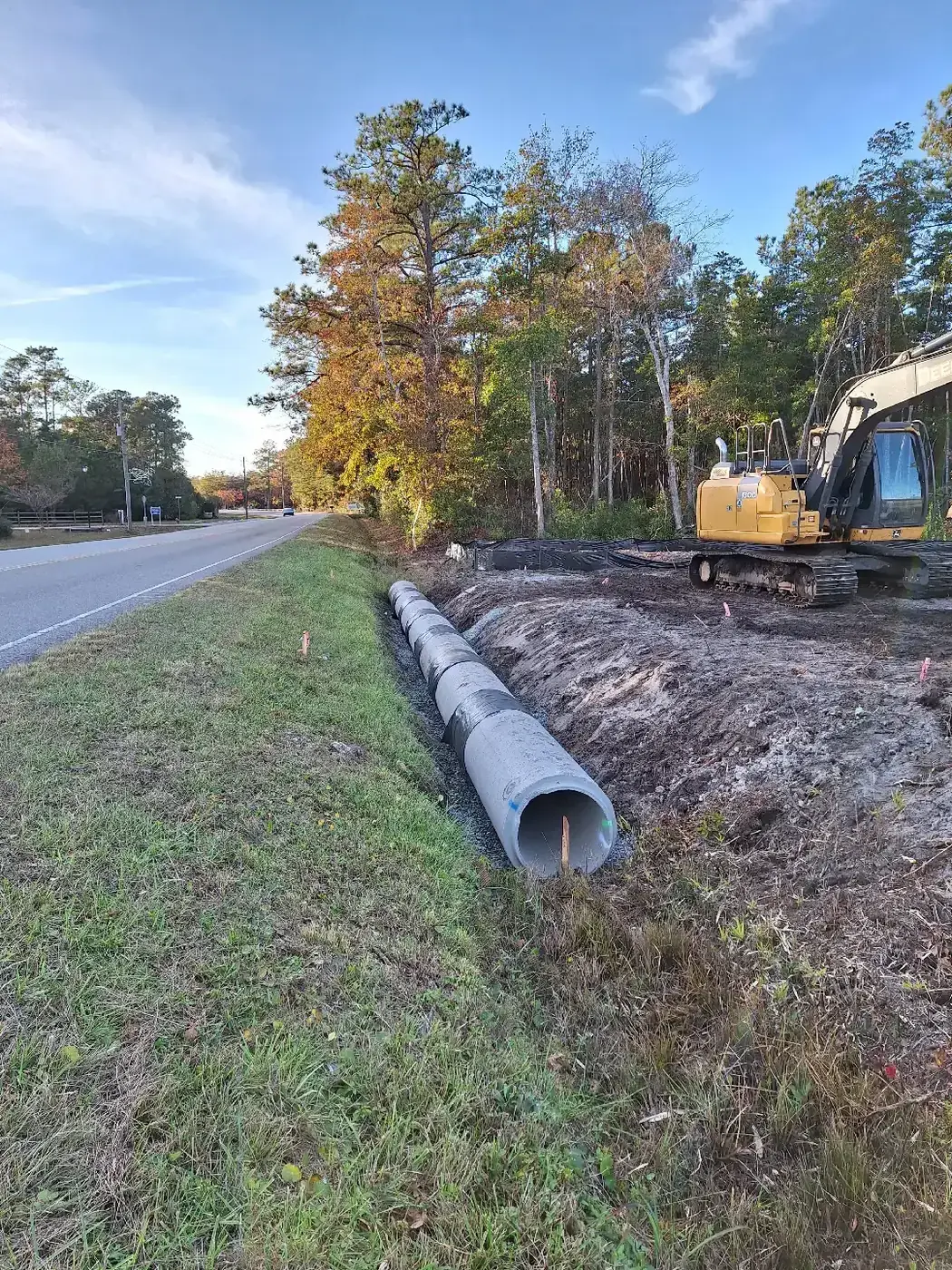
Water collected in ditches or pipes on private property cannot go into the highway drainage system without NCDOT’s prior approval. Where a driveway crosses a highway ditch, an approved pipe size goes in the ditch. The low point of the drive sits at or close to the ditch line. Setting that pipe at ditch grade and shaping the ditch around it is our driveway culvert installation work.
What Are the Driveway Pipe Rules?
The District Engineer sizes the pipe for the flow expected in the ditch. The policy sets a floor of 15 inches inside diameter, and single-family pipe tops out at 48 inches. The District Engineer can direct otherwise on either limit. The minimum length is 20 feet.
Who sets the pipe depends on the property. Under the state’s driveway pipe rule, 19A NCAC 02D .0421, NCDOT installs the pipe at its own expense for a farm entrance or a home lot. The condition is that the property owner buys the pipe and delivers it to the site. The rule applies when the property does not already have a way in and out, and a lot being developed to sell does not qualify. Pipe over 48 inches is the property owner’s to furnish and install.
Commercial property has two routes under the same rule. NCDOT can set a pipe the owner furnishes, with an application and a payment of $10 per linear foot. Or the owner can hire a private contractor and pay $50 for NCDOT’s inspection of the work. Either way, the commercial driveway permit comes first. Ask the District Engineer’s office for its approved list of pipe materials before you buy. If environmental permits are required, the policy puts those permits and the pipe work on the property owner.
Driveway pipes and culverts properly installed in the right of way under a permit become NCDOT property. NCDOT maintains the drainage through them. For single-family homes, NCDOT provides new pipe to replace damaged pipe.
NCDOT Driveway Permit Fee and Timeline
NCDOT charges no fee to apply for a driveway permit. Its FAQ says some charges may come up for services such as inspections. The Street and Driveway Access Permit Application lists a $50 construction inspection fee. The form says that fee is reimbursed if the application is denied.
The paperwork is the cheap part. The form puts the entire cost of building and maintaining the approved connection on the property owner.
Timing depends on the request. NCDOT says small or simple requests are typically processed in four weeks or less after formal submittal. Complicated requests can take eight weeks or more.
Apply early. The policy says local governments and NCDOT generally agree to hold building permits until the driveway permit is approved. After approval, construction must start within one year. The District Engineer may grant an extension of up to 90 days.
The Permit at a Glance
| Item | What NCDOT says |
|---|---|
| Application fee | None |
| Inspection fee | $50 on the application form, reimbursed if the application is denied |
| Review time | Four weeks or less for simple requests, eight weeks or more for complex ones |
| Pipe size | 15 inch minimum inside diameter, unless the District Engineer directs otherwise |
| Pipe length | 20 feet minimum |
| Who sets home or farm entrance pipe | NCDOT, at its expense, if the property owner furnishes and delivers the pipe |
| Commercial pipe | NCDOT sets it for $10 per linear foot, or a private contractor installs it with a $50 inspection payment |
| Start deadline | Within one year of approval, plus up to 90 days if the District Engineer grants it |
Source: NCDOT Driveway Permit FAQ, NCDOT Street and Driveway Access Permit Application, NCDOT Policy on Street and Driveway Access (July 2003), and the state driveway pipe rule, 19A NCAC 02D .0421.
How to Apply for an NCDOT Driveway Permit
Start local. NCDOT says to contact the city or county that controls land use and development approvals first. It also encourages a call to the local District Engineer’s office at that same early step. If local rules are stricter than NCDOT’s, the policy says the local rules govern.
Then go to NCDOT. The FAQ says you must contact a local NCDOT District Engineer’s office for the permit.
All five counties we work in sit in NCDOT’s Highway Division 3. Its staff directory puts Onslow and Pender in District 1 and Duplin in District 2. Brunswick and New Hanover are in District 3.
You can also apply online. NCDOT’s March 2024 user guide covers filing on the Connect NCDOT Permits site with an NCID username and password. You get an email confirmation with a Driveway Permit ID. You can track its status on the Permits Dashboard.
After approval, the form tells you to notify the District Engineer when work begins and when it is completed. The policy also requires final approval by the District Engineer before the access opens for public use.
After the Permit: Building the Driveway
The permit covers the connection to the road. When NCDOT sets the pipe, the rule covers the digging, the pipe and enough backfill to protect it, and it says NCDOT is not obligated to build a finished driveway. The rest of the drive runs across your own land. We cut and grade it back to the house site, then stone it as a gravel driveway. If trees and brush still stand in the way, land clearing comes first.
Building a new house? The drive is one part of site prep on a raw lot, with the clearing and the building pad.
A construction entrance off a state road can need its own paperwork. NCDOT’s policy lets the District Engineer issue temporary access permits for a set period. Its examples include grading operations and site construction accesses.
The lot itself can need other permits. Our guide to coastal land clearing permits covers those.
We are based in Burgaw and work across Pender, New Hanover, Onslow, Brunswick and Duplin counties. The estimate is free and comes from looking at the property. Call (910) 512-9578 and tell us which road the drive will meet.