
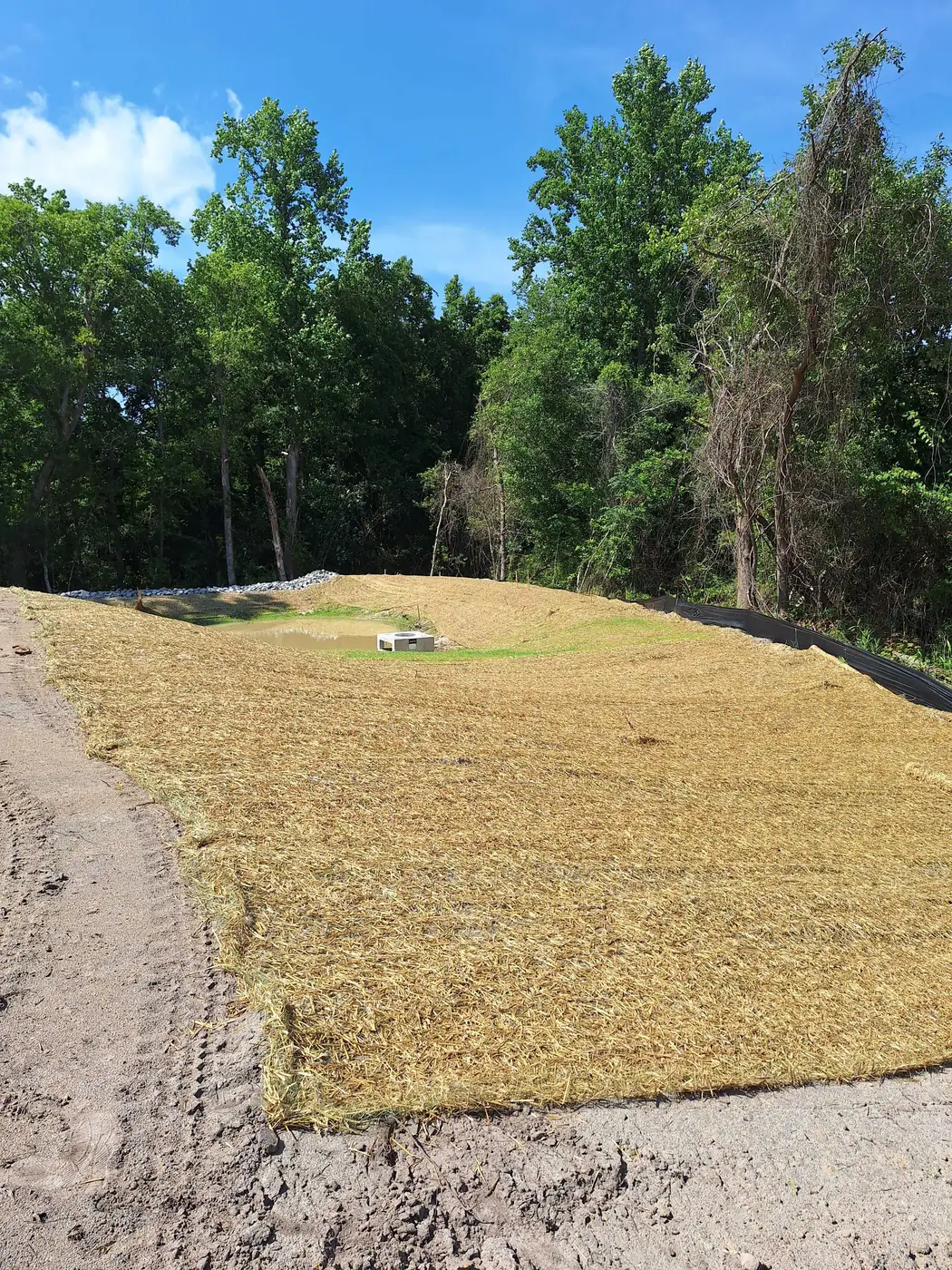
Retention Pond vs. Detention Pond in North Carolina
A retention pond keeps a permanent pool of water in it, even between storms. A detention pond fills up during a storm, then drains back to dry ground. Both slow storm water down before it leaves a site. The retention pond also gives mud and fine soil time to settle out in its standing water.
North Carolina’s design rules use other names for the two. A retention pond is a wet pond under 15A NCAC 02H .1053. A detention pond is a dry pond under 15A NCAC 02H .1062. We dig both kinds on commercial jobs as part of our pond construction work, built to the engineer’s approved plan.
What Is the Difference Between a Retention Pond and a Detention Pond?
The difference is the water left behind once a storm passes. In a wet pond, the lowest outlet sits above the pond bottom. NCDEQ’s design manual says that is what creates the permanent pool. Storm water rises above that pool, then drains back down to it.
A dry pond holds water right after a storm, then drains until it is almost dry. NCDEQ says its main job is to slow down and delay storm runoff peaks. Under the state rules, both types let the storm water out over two to five days.
That standing pool does real work. Water sitting in a wet pond lets sediment settle before it leaves. NCDEQ rates the pollutant removal of dry ponds as low. So the state counts a wet pond as a primary treatment measure and a dry pond as a secondary one.
How North Carolina’s Wet Pond and Dry Pond Rules Compare
Each type has its own minimum design rules. The plan for your site has to meet the rule for the type it uses.
| Design point | Wet pond (retention) | Dry pond (detention) |
|---|---|---|
| State rule | 15A NCAC 02H .1053 | 15A NCAC 02H .1062 |
| Water between storms | A permanent pool | Almost dry, with a small pool near the outlet |
| Depth | Main pool averages 3 to 8 feet | Temporary pool 10 feet deep at most |
| Storm water drains down in | 2 to 5 days, back to the pool | 2 to 5 days |
| Water table | No water table rule | Lowest point at least 6 inches above the seasonal high water table |
| Catching sediment | A forebay holding 15 to 20 percent of the main pool’s volume | Pretreatment, such as a forebay or a grassed swale |
| Edge or bottom | A vegetated shelf at least 6 feet wide, no steeper than 6:1 | Bottom graded evenly toward the outlet |
| State treatment rating | Primary measure | Secondary measure |
Sources: 15A NCAC 02H .1053 and .1062, the definitions in 15A NCAC 02H .1002, and the NCDEQ Stormwater Design Manual, chapters C-3 (wet pond) and C-12 (dry pond).
Why Do Coastal Sites Lean on Wet Ponds?
One line in the dry pond rule matters a lot on the coast. The lowest point of a dry pond must sit at least six inches above the seasonal high water table. The state defines that as the highest level of saturated soil in a year with normal rainfall.
NCDEQ explains the reason. With less separation, a dry pond can grow pools of standing water in wet weather. The current wet pond rule has no water table requirement at all. That gives a wet pond room to work where the ground stays wet.
Coastal towns deal with high water too. The Town of Oak Island, in Brunswick County, says high water tables make its stormwater harder to manage. Daily tidal changes and flat ground are on the same list. State rules say the water table level can be found from soil clues, monitoring or modeling.
When Does the Coastal Stormwater Rule Apply?
North Carolina’s coastal stormwater rule, 15A NCAC 02H .1019, protects surface waters in the 20 coastal counties. Pender, New Hanover, Onslow and Brunswick are all on the state’s list of coastal counties. Duplin County is not on that list.
In those counties, the rule applies to projects that need an erosion and sedimentation control plan. State law requires that plan when a job will disturb more than one acre. The rule also covers projects that need a CAMA major development permit. It reaches nonresidential projects that add 10,000 square feet or more of built-upon area, too.
Built-upon area means surfaces that keep water from soaking into the soil, as state law defines it. A wet pond is one of several primary measures on the state’s list. Stormwater wetlands, sand filters and infiltration systems are on it too. Our guide to land clearing permits in coastal North Carolina covers the erosion control side.
What Goes Into Digging a Retention Pond?
A wet pond starts with the forebay, a smaller pool where storm water comes in first. The rule sizes it at 15 to 20 percent of the main pool’s volume. Its entrance has to be deeper than its exit. NCDEQ’s manual notes that forebays trap sediment.
The main pool averages three to eight feet deep below the permanent pool. The forebay and main pool both keep at least six inches of extra depth to hold sediment. A vegetated shelf at least six feet wide rings the main pool. Its slope can be no steeper than 6:1, which is six feet out for every foot down.
Grassed side slopes on a stormwater pond can be no steeper than 3:1. Steeper grassed slopes may be accepted case by case if the applicant shows they will stay stable. A dry pond’s bottom is graded evenly toward the outlet. The rule allows no low or high spots, other than an optional low flow channel.
State rules say the outlet must not cause erosion downhill during the peak flow of a 10-year storm. We set rip-rap at the outlet where the plan calls for it. It is the same rip-rap outlet and drainage work we do at ditches and culverts. Our excavators dig the pools, and the tracked skid steer dresses the shelf and banks.
Who Designs the Pond and Who Digs It?
An engineer designs the pond and seals the stormwater plan. The property owner or developer applies for the permit. The approved plan sets every grade, depth and elevation we build to.
We do the site work and the digging. That covers clearing the site, digging the forebay and main pool, and shaping the banks and the vegetated shelf. We set rip-rap at the outlet to the approved plan. On commercial jobs, the pond is one piece of our site prep work, along with clearing, grading and building pads.
Retention Pond or Detention Pond: Which Fits Your Site?
Your engineer makes the call, and a few site facts drive it. A high water table points toward a wet pond, since a dry pond needs six inches of separation. A dry pond also counts only as a secondary measure. NCDEQ says it can work in a treatment train with another measure.
NCDEQ notes the permanent pool of a wet pond draws children to play. The vegetated shelf helps by discouraging children from wading in. A dry pond sits mostly dry, with grass on its banks. Poor grading leaves puddles, and NCDEQ says those can breed mosquitoes.
Our pond construction cost guide covers farm and recreational ponds, a different job with different costs. For a stormwater pond, we work from your approved plan and are based in Burgaw. Call (910) 512-9578. The estimate is free and comes from looking at the property.