
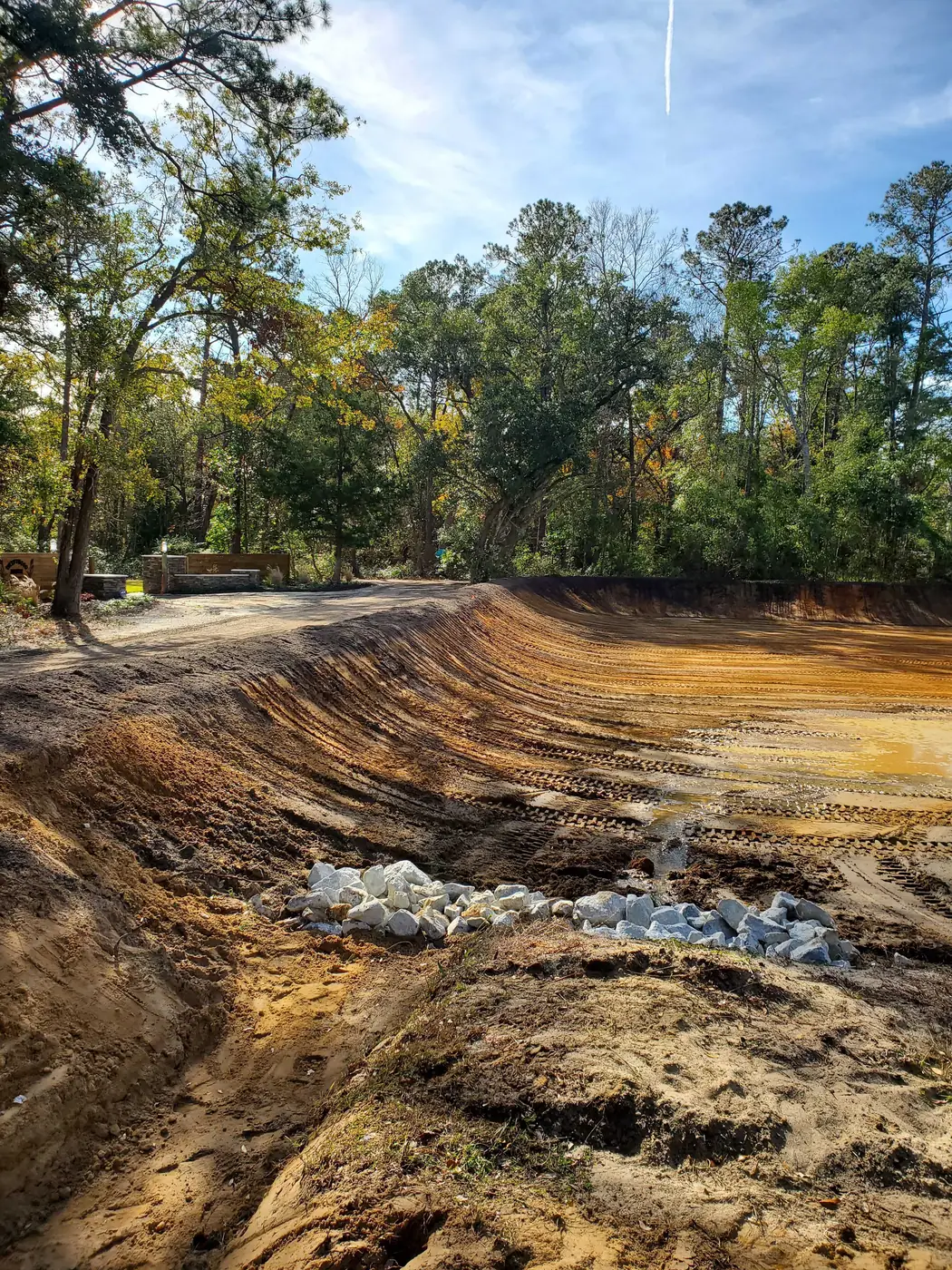
How Much Does Excavation Cost in North Carolina?
Published cost data from HomeGuide puts the average excavation job at about $1,100 to $5,600 total. By volume, its February 2026 guide lists $2.50 to $15.00 per cubic yard. HomeAdvisor’s June 2026 guide puts excavation projects at $1,659 to $6,713, with most residential jobs landing around $3,976.
HomeGuide says the price depends on the dirt type, depth, terrain, obstructions and amount of earth moved. On a coastal lot, watch two of those closely: how wet the ground is and where the dirt goes. Our excavation work covers Pender, New Hanover, Onslow, Brunswick and Duplin counties.
What Do Common Excavation Jobs Cost?
The table lists published national ranges for common residential digs. Use it to check a quote against the market.
| Job or rate | Published range | Source |
|---|---|---|
| Average excavation job | $1,100 to $5,600 | HomeGuide |
| Average excavation job | $1,659 to $6,713, most near $3,976 | HomeAdvisor |
| Excavation per cubic yard | $2.50 to $15.00 | HomeGuide |
| Excavator with operator | $100 to $300 per hour | HomeGuide |
| Minimum project fee, where charged | $500 to $800 | HomeGuide |
| Home site excavation | $1,500 to $10,000 | HomeGuide |
| Driveway or patio pad | $1,000 to $2,500 | HomeGuide |
| Trenching | $5 to $12 per linear foot | HomeGuide |
| Cut and fill on the same lot | $1 to $12 per cubic yard | HomeAdvisor |
| Hauling dirt off site | $8 to $25 per cubic yard | HomeAdvisor |
Sources: HomeGuide’s excavation cost guide, February 2026, and HomeAdvisor’s excavation cost guide, updated June 2026.
These are national ranges. The rows overlap, so they do not add up to one total. HomeAdvisor notes that even a tiny trench can trigger a base charge.
What Moves the Price on a Coastal Lot?
Soil comes first. HomeGuide says sand or light soil costs the least to dig. Its table puts light soil at $2.50 to $6.00 per cubic yard and average soil at $6.00 to $10.00. Heavy or wet soil, or loose rock, runs $10.00 to $15.00.
Access comes next. HomeAdvisor says a compact skid steer or backhoe with an operator costs about $100 per hour. A full-size excavator runs roughly 50 percent more per hour, but its larger bucket can cut the total hours. Tight access can mean smaller dump trucks and extra trips.
We bring excavators, a tracked skid steer and a dump truck, so the machine can match the lot. If the lot is still wooded, land clearing comes first. HomeAdvisor budgets $1,400 to $5,800 for clearing trees, shrubs and debris before a dig.
Is It Cheaper to Keep the Dirt or Haul It Off?
Keeping it on the lot usually costs less. HomeGuide says costs increase when dirt is trucked to or from the site instead of moved on site. HomeAdvisor puts cut and fill work at $1 to $12 per cubic yard. Hauling dirt off site runs $8 to $25 per cubic yard.
HomeAdvisor says easy access for a dump truck keeps hauling near the low end. A long haul to the disposal site pushes it toward $25. Its budget tips say to reuse clean fill on site instead of paying to haul it away.
Cut and fill takes dirt from the high spots and uses it to build up the low spots. That reshaping is the core of our grading and dirt work.
Some lots need more dirt than they have. We haul fill dirt in by the load and spread it with our machines. HomeGuide puts fill dirt at $5 to $25 per cubic yard on average.
How Much Is Excavation Work Per Hour?
HomeGuide puts excavator hourly rates at $100 to $300 per hour. That covers an operator with their own mini excavator, backhoe or skid steer. Hiring an operator without equipment costs $50 to $150 per hour. HomeAdvisor lists combined labor and machine rates of $120 to $150 per hour.
HomeGuide says most excavation contractors charge by the cubic yard or the total project. Some charge by the hour for small projects, and most operators charge a minimum of one day or eight hours. Many also set minimum project fees of $500 to $800, which sets the floor for a small dig.
What Does a House Pad or Driveway Pad Cost?
HomeGuide puts home site excavation at $1,500 to $10,000 on average. It says the foundation size, depth and terrain set where a job lands. Excavating a driveway or patio pad runs $1,000 to $2,500 on average. HomeGuide says that price typically includes grading and compacting the dirt.
On a low lot, we build the pad up with fill packed in layers. That lifts it above the ground around it. That work is part of our site prep for homeowners and builders. Our guide to site prep cost in North Carolina covers clearing, culverts and permit fees too.
How Much Does a Trench Cost?
HomeGuide puts trenching at $5 to $12 per linear foot. At that rate, a 200 foot trench works out to about $1,000 to $2,400. A short trench can still hit the minimum fee.
Depth changes the math. At 5 feet and deeper, OSHA requires a protective system against cave-ins unless the trench is in stable rock. One OSHA option slopes the walls no steeper than one and a half feet across for every foot down. A sloped trench is wider at the top, so more dirt moves.
Which Rules Apply Before a Dig in North Carolina?
The first rule is the utility locate. Under G.S. 87-122, the person responsible for an excavation must notify the Notification Center. Notice goes in no less than three full working days before the dig starts. It expires 28 calendar days after the work start date, so a longer job needs a new notice.
Sometimes the dig area cannot be clearly identified in the notice. Then the statute calls for premarking it with white paint, flags or stakes. HomeGuide points readers to 811, the national call-before-you-dig number.
The second rule is OSHA’s cave-in standard, 29 CFR 1926.652. Workers in an excavation need a protective system against cave-ins.
The exceptions are stable rock, or a dig under 5 feet deep with no sign of a possible cave-in. That call belongs to a competent person who examines the ground. Both rules shape the plan for any dig, even a short trench.
Two more rules can apply. Under G.S. 113A-57, land disturbance of more than one acre needs an erosion and sedimentation control plan. Pender County requires a Flood Development Permit for all building in the floodplain. The property owner applies for those.
Get a Free Estimate on Your Excavation
We are based in Burgaw and have been in business since 2013. Our excavation runs on excavators, a tracked skid steer and a dump truck. HomeGuide says an accurate excavation estimate takes an in-person site visit. Ours is free and comes from looking at the property, and scheduling is usually within days.
Call (910) 512-9578 and tell us what you need dug and where the dirt should end up. If the spot holds water after a hard rain, mention that too.