
How Much Does Concrete Removal Cost in North Carolina?
Published cost data from Angi puts professional concrete removal at about $542 to $1,744, with labor and disposal included. HomeGuide reports a concrete driveway at $1,200 to $4,500 on average. Angi’s guide, updated September 16, 2026, lists the Southeast at $6 to $10 per square foot.
Those are market figures from cost guides, not a quote. Your number depends on the size and thickness of the concrete and the steel inside it. Access for the machines, the haul distance and the dump fee move it too.
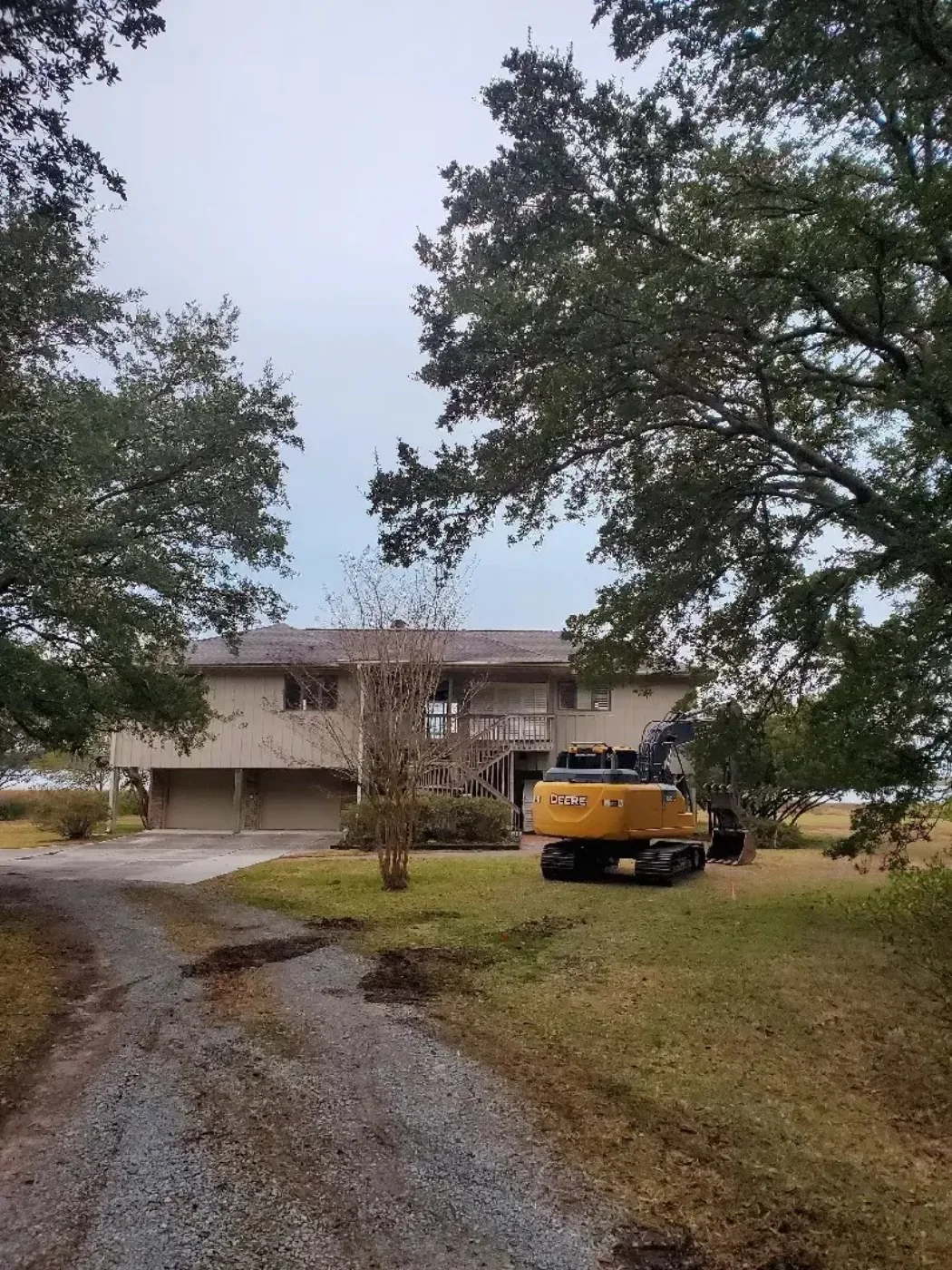
We break out old slabs, driveways, walkways, patios and pads with our excavators and tracked skid steer. That is part of our demolition and concrete removal work, and the pieces leave in our dump truck.
What does concrete removal cost by project?
The table puts two national cost guides side by side. Read the low end as a thin slab with open access. Read the high end as thick or reinforced concrete in a tight spot.
| Project | Angi (2026) | HomeGuide |
|---|---|---|
| Driveway | $1,000 to $2,500 | $1,200 to $4,500 on average |
| Slab | $800 to $2,500 | $300 to $800 for a 10 by 10 foot slab |
| Patio | $1,000 to $2,000 | $1,200 to $3,000 for a 20 by 20 foot patio |
| Sidewalk or walkway | $900 to $2,500 | $750 to $1,250 for 50 feet of sidewalk |
| Steps | $300 to $800 | $250 to $500 |
Sources: Angi’s concrete removal cost guide (updated September 16, 2026) and HomeGuide’s concrete removal cost guide. Neither table is specific to North Carolina.
By the foot, Angi prices most removal at $2 to $6 per square foot, labor and dumping fees covered. Its regional table runs higher for the Southeast. Angi also notes that some contractors price large slabs by the ton instead.
What moves the price on a concrete removal job?
Size. HomeGuide says smaller jobs cost more per square foot than large ones. A small pad still takes a trip with the machines.
Thickness. Angi says contractors treat 4 to 6 inches as the standard thickness. A slab just 1 or 2 inches thicker can lead some contractors to double their price.
Rebar or wire mesh. HomeGuide puts reinforced concrete at $1 to $3 more per square foot. The steel has to be cut and hauled out with the rest. Angi puts reinforced slabs at about $6 per square foot or more.
Access. Angi says hard to reach, hazardous or steep spots raise the cost. They often run $6 per square foot or more. A patio behind the house is slower work than a driveway at the road.
Haul distance and the dump fee. HomeGuide notes extra mileage fees when concrete travels farther to be dumped. It puts dump fees at $90 to $160 per ton, set by local landfill policy. The Onslow and Brunswick county landfills charge by the ton, and concrete is heavy.
Where does broken concrete go in North Carolina?
NCDEQ counts unpainted concrete as inert debris, along with brick, concrete block, uncontaminated soil, rock and gravel. Its guidance for contractors says to dispose of all waste at a permitted facility. A permitted land clearing and inert debris landfill, called an LCID landfill, is one place it can go.
Concrete mixed with wood, sheetrock or shingles is a different load. NCDEQ calls that construction and demolition debris, or C and D. County fees show why keeping concrete clean pays:
- Onslow County’s current adopted fee schedule lists LCID, which includes concrete, at $34 per ton. Construction and demolition debris runs $60 per ton.
- Brunswick County’s landfill lists clean concrete, brick and soil at no charge. Painted concrete does not get that rate, and mixed LCID runs $59 per ton.
- Pender County’s transfer station in Hampstead lists bricks and cement as not accepted. The county points contractors with large loads of debris to the Sampson County Landfill.
So the same slab costs a different amount to dump depending on the county and what is mixed in. Angi also suggests asking about concrete recycling programs, which can offer lower rates.
Can clean concrete stay on your land as fill?
Sometimes. North Carolina’s beneficial fill rule is 15A NCAC 13B .0562. It covers using inert debris to level land or bring it to grade. No solid waste permit is needed when the fill meets the rule’s conditions, which include:
- No digging to create or expand the fill area.
- Where no local ordinance covers it, the fill is limited to one year and one acre.
- It gets covered with at least one foot of compacted soil. Slopes can be no steeper than three feet across for every foot up.
- It stays out of waters of the State and above the seasonal high groundwater table.
- Local zoning, floodplain, wetland and erosion control rules still apply.
Digging a hole to bury broken concrete is not beneficial fill. NCDEQ’s guidance for contractors says not to bury, burn or dump waste.
On a low lot where water sits close to the surface, the groundwater condition can rule fill out. Check with your county before any broken concrete goes in the ground.
Do you need a permit to remove concrete?
It depends on where the property sits. Angi says concrete demolition permits cost $25 to $200 in the places that require them. The property owner applies for any permit. Ask your county or town inspections office before the work goes on the calendar.
What happens to the ground after the slab comes out?
Pulling out a slab or driveway often leaves a shallow low spot and bare, packed dirt. Our grading and dirt work shapes that ground so water drains off instead of collecting there. Where the low spot needs fill, we haul it in by the load and spread it.
A cracked concrete drive can become a gravel driveway in the same footprint. We grade the base and spread the stone. New concrete is a concrete contractor’s job, and we do not pour it.
How does a concrete removal job run?
- We look at the concrete, the access and the path out for the dump truck.
- Our excavators and tracked skid steer break the concrete into pieces and lift them out.
- The pieces go in our dump truck and leave for a facility that takes them.
- We grade the ground and bring in fill or stone if the job calls for it.
HomeGuide says most concrete slabs take 1 to 2 days to remove. A whole house coming down is a bigger job with its own state rules. Our house demolition cost guide covers full teardowns.
Getting a number for your concrete removal
No cost guide can see your slab. Size, thickness, steel, access and the haul set the number. Based in Burgaw, we work across Pender, New Hanover, Onslow, Brunswick and Duplin counties. We can usually schedule within days.
Call or text (910) 512-9578 with the address and what is coming out. The estimate is free and comes from looking at the property.