
What Is Bush Hogging? (And When Your Land Needs It)
Bush hogging is mowing heavy growth with a rotary cutter pulled behind a tractor. It cuts tall grass, weeds, briars and saplings a few inches thick. You may hear the same work called brush mowing or brush hogging.
The name comes from Bush Hog, a cutter brand built in Selma, Alabama. The brand name became the everyday word for the job, the way people say Weed Eater for any string trimmer.
How a rotary cutter works
A rotary cutter is a heavy steel deck with blades hanging underneath it. The tractor drives those blades through the power take off shaft and carries the deck on a three point hitch. Blade tips move over 150 miles per hour.
The blades hang on hinges instead of bolting solid. When a blade hits a rock or a hidden stump, it swings back out of the way. Centrifugal force throws it right back out to cut again.
The blades are blunt on purpose. They are heat treated high carbon steel, up to an inch thick. A heavy dull blade whacks through a briar patch. A thin sharp blade gets caught and stalls.
That build is the whole difference. A finish mower cuts grass. A rotary cutter survives ground that hides bottles, wire and old fence posts.
What bush hogging cuts, and what it leaves
A rotary cutter takes down growth a mower cannot touch:
- grass and weeds taller than a person
- briars, blackberry canes and honeysuckle
- young pines and sweetgum saplings
- old pasture and hay ground gone to brush
- light limbs and brush dropped by a storm
Industry guides put the working limit near 2 to 3 inches of stem. Larger stems bend under the deck instead of cutting, and they can damage the machine.
Bush hogging works above the ground. It leaves stubble, stumps and roots in place, so growth comes back. That makes it repeat maintenance you schedule, which is exactly what most landowners want. A field stays open and walkable for the price of one pass a year.
Bush hogging vs forestry mulching vs land clearing
These three get used as if they mean the same thing. They do different work at very different prices.
| Service | What it handles | What is left | Common market range per acre |
|---|---|---|---|
| Bush hogging | grass, weeds, briars, saplings to about 3 inches | stubble, stumps and roots, growth returns | about $50 to $200 |
| Forestry mulching | brush and small trees, larger stems | a mulch layer over the ground, stumps cut low | about $400 to $2,500 |
| Land clearing | everything down to workable dirt, stumps pulled | bare ground ready to build or grade | about $1,800 to $5,500 |
Those ranges come from published national cost guides, not from us. Every property prices on its own.
Bush hogging is the maintenance pass. It keeps ground you already own from closing in.
Forestry mulching is the reset. One machine grinds standing brush and small trees into a mulch layer. That layer stays on the ground, so nothing gets hauled off. A mulcher covers about 1 to 3 acres a day, depending on the growth.
Land clearing is the build step. Vegetation, stumps and roots come out with an excavator. The dirt then gets hauled or shaped for a house pad, a shop or a field.
How often does overgrown land here need a pass?
Southeastern North Carolina grows brush most of the year. The Wilmington area averages roughly 245 to 260 frost free days, depending on the source. Published frost dates put the last spring frost in March and the first fall frost in November. Growth runs hardest from May into September, and it jumps after heavy rain.
Price follows how long you wait. North Carolina brush hogging guides sort fields by condition:
- mowed within the past year: about $50 to $90 per acre
- one to two seasons of growth: about $90 to $140 per acre
- three or more years of growth: about $140 to $200 per acre
One pass a year holds a field in the cheapest tier. Two passes a season keeps a pasture or a homesite looking cut. Farm guidance for pastures often lands on two to three clippings across a growing season.
Let a field sit five years and a cutter may not be the right machine at all. Stems get too thick, and the job moves to mulching.
What does bush hogging cost?
Cost guides for North Carolina work put brush hogging at about $50 to $200 per acre. Most jobs land between $75 and $150. National guides run higher on rough acreage, listing $150 to $600 per acre.
Hourly pricing is common too. North Carolina guides list $60 to $150 per hour. National benchmarks sit near $85 to $120 per hour for a tractor and a six foot cutter. Small jobs usually carry a minimum of $150 to $300 for loading and hauling the equipment.
Big tracts price better per acre. Guides show per acre rates dropping 20 to 30 percent as acreage goes up. One trailer trip spreads across more ground.
Again, these are published market ranges for the service. Your number depends on the field.
Signs your land is ready for a pass
- you cannot see your property line, ditch or fence anymore
- growth is tall enough to hide holes, trash and old wire
- ticks and snakes are working their way toward the house
- you are listing the property and it shows badly
- a survey crew or an appraiser needs to get across it
- young pines are starting to come up through the grass
That last one matters most for cost. Saplings are cheap to cut this year and expensive to grind in three years.
When mulching is the better call
Some ground is past mowing. If the stems are thicker than your wrist, a rotary cutter will bog and bounce over them. If the tract has not been touched in five years, expect a mix of brush and real saplings.
Mulching costs more per acre, but it handles that material in one pass and leaves the mulch as ground cover. On a lot you plan to build on, clearing is the honest starting point. An excavator pulls the stumps and the dump truck hauls them out.
We look at what is standing before we quote a machine. Sometimes the cheap answer is the right one.
Timing and ground on the coastal plain
Sandy soil drains fast, so most of our ground firms up quickly after rain. Low spots are the exception. Where the water table sits high, ground can stay soft into summer, and heavy equipment will rut it.
Hurricane season adds its own work. Storms drop limbs and open the canopy, and brush jumps the following spring. A pass after storm season resets a field before that push.
Winter has an advantage too. With the leaves down, you can see what is actually out there before anyone starts cutting.
What the field looks like after
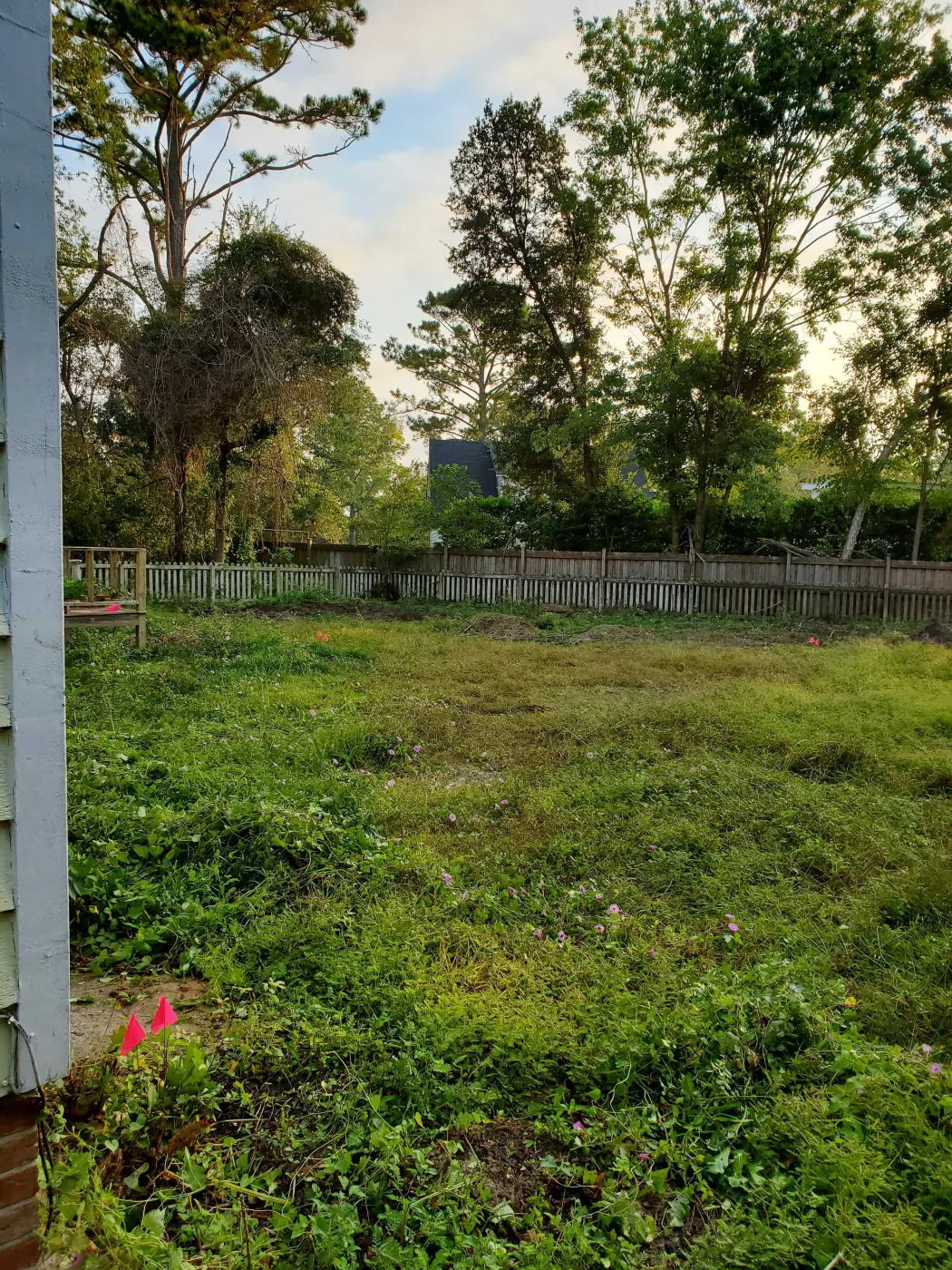
Expect a rough, tan look for a week or two. Stubble mats down and green growth comes through underneath. Chopped material breaks down on the ground and feeds the soil back.
The stumps and roots stay put. If you want a spot cleared for good, that is a mulching or clearing conversation instead.
Coastal Brush Mowing has been cutting overgrown land in Pender, New Hanover, Onslow and Columbus counties since 2013. Call or text (910) 512-9578 for a free estimate on your field.