
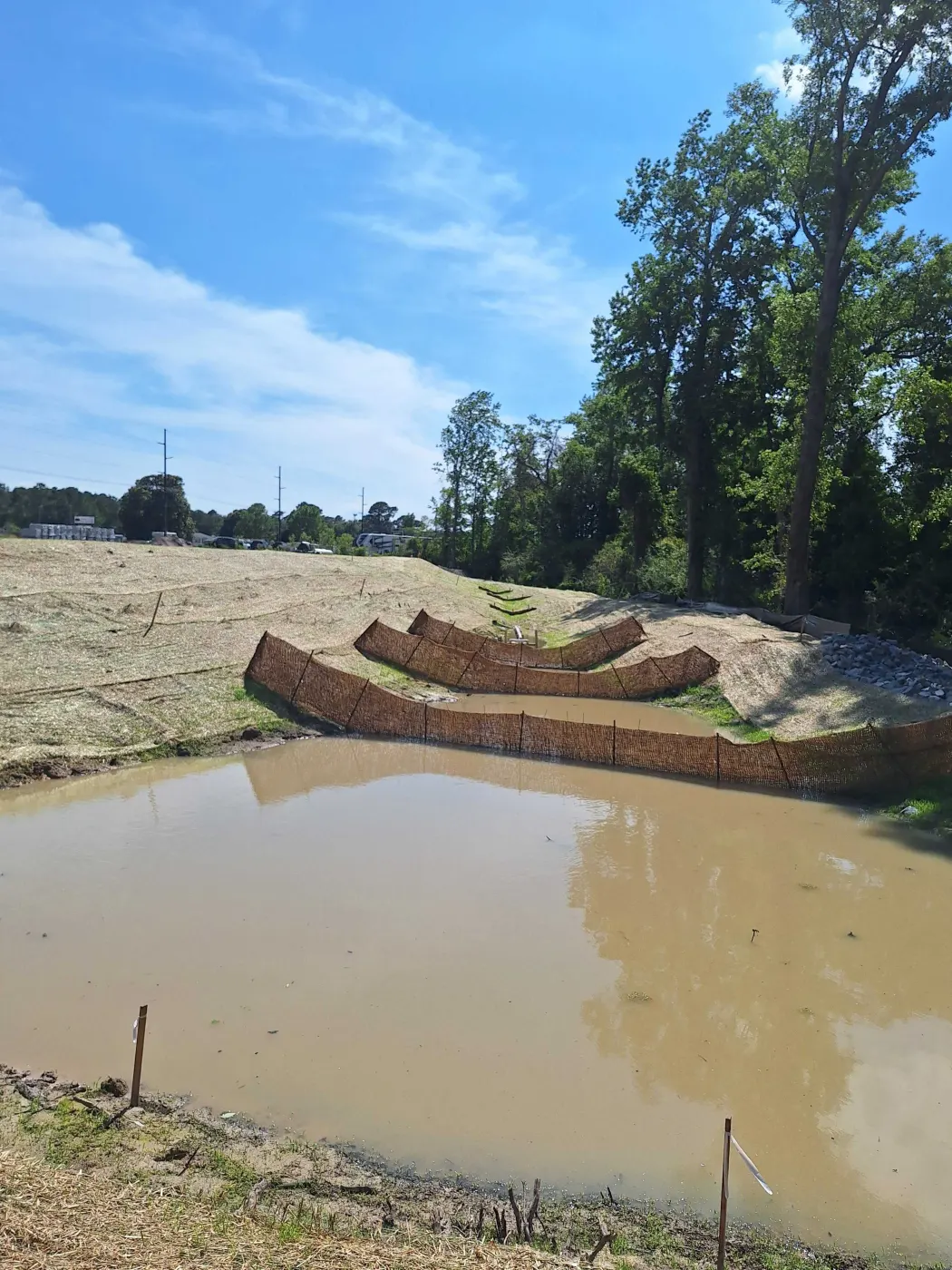
How Much Does It Cost to Build a Pond in North Carolina?
Published cost guides put most farm ponds between $2,000 and $10,000. Priced by the acre, a one-acre pond gets reported at $1,400 to $4,800 per acre. Dug ponds under 20 acres are often quoted nearer $3,000 to $5,000 per acre. A deep stocked fishing pond can run $10,000 to $75,000.
Those are national market ranges. Your number comes from the dirt under your grass.
We build ponds out of Burgaw and have been running machines since 2013. Below is where the money goes, what coastal soil does to the price, and which permit rules come into play.
What do ponds cost by type?
| Pond type | Reported market range |
|---|---|
| Backyard pond | $3,000 to $15,000 |
| Farm pond | $2,000 to $10,000 |
| Fishing pond | $10,000 to $75,000 |
| Small lake | $30,000 to $50,000 |
| Priced per acre, one acre | $1,400 to $4,800 per acre |
| Priced per acre, ponds under 20 acres | $3,000 to $5,000 per acre |
Those ranges overlap and disagree with each other. That is normal for dirt work. Every source is pricing a different job on different ground.
What drives the price of a pond?
Soil. Clay holds water. Sand lets it go. A sandy site may need a clay core, hauled-in clay, or a liner. Guides price bentonite clay near $1.05 to $2.50 per square foot. Sheet liners run lower, roughly $0.30 to $2.30 per square foot depending on material.
Depth. Price follows cubic yards, not surface area. Two extra feet of depth across an acre moves thousands of additional yards.
Spoil. Dug dirt has to land somewhere. Spreading it on site is cheap. Trucking it off is not, with published rates near $105 to $175 per cubic yard.
Clearing. Wooded ground needs trees and roots out first. Guides list land clearing near $120 to $265 per hour. On brushy acreage, forestry mulching can open the area before the excavator starts.
Access. The machine has to reach the spot. Soft ground, narrow gates and long walk-ins add hours before the first bucket moves.
Water control. A pond that holds back a low area needs a safe path for storm water. Shaping that outlet adds dirt work and pipe.
Permits. Published permit fees sit near $150 to $485. Wetland review costs more in time than in money.
Dug pond or dammed pond?
A dug pond is a hole. You excavate down toward the water table or line the basin, and the sides do the holding. Price tracks yardage and haul distance.
A dammed pond blocks a low draw and backs water up behind an embankment. It can flood more surface area for less digging. It also brings in dam rules, storm water paths and more design work.
Coastal plain ground is flat, so many sites here suit a dug pond better than a dam.
Will sandy soil hold water in coastal North Carolina?
Not on its own. Southeastern North Carolina sits on the coastal plain, and sandy soils are common under pine flatwoods. Clean sand drains, so a hole cut into it often will not stay full.
Plenty of sites still carry clay lower in the profile. Test pits show whether the layer is there and how deep it sits. A few hours of digging before design beats chasing a leak afterward.
How do I check my soil before I spend money?
Start with free data. USDA runs the Web Soil Survey at websoilsurvey.nrcs.usda.gov. You draw your land as an Area of Interest, view the soil map, and print a report.
The tool includes suitability ratings. NRCS still says onsite investigation is needed for engineering work. Use it as a first look, then dig pits and see the layers yourself.
Does a high water table help or hurt?
Both. Low spots near the coast can sit close to groundwater. A high table can keep a pond full without a large watershed feeding it.
The same water fills the hole while the machine is working in it. That slows excavation and can change the finished shape. Wet ground also raises the wetland question.
Do I need a permit to build a pond in North Carolina?
It depends on where the water goes and how much ground gets disturbed. Four rules cover most ponds.
Wetlands and streams. Section 404 of the Clean Water Act covers dredged or fill material. That means material placed in waters of the United States, including wetlands. The Army Corps of Engineers makes those calls. Section 404(f) does exempt construction and maintenance of farm or stock ponds. The recapture rule can undo that exemption. It applies when the work is a new use. The work also has to reduce the reach or impair the flow of the water. EPA states that a discharge converting a wetland to upland needs a 404 permit.
Dam safety. North Carolina’s Dam Safety Law exempts smaller dams. The line sits under 25 feet in height or under 50 acre-feet of storage. That exemption fails if the state finds failure could cost lives or cause serious property damage. Dams built and kept to supply agricultural water can also be exempt. A licensed engineer or qualified personnel must approve the design, and the dam must be registered. High-hazard dams get no exemption.
Erosion control. The Sedimentation Pollution Control Act sets a one-acre line. Land-disturbing activity that disturbs more than one acre on a tract needs an approved plan. File it 30 or more days before work starts. The agency then has 30 days to act. Agricultural production is exempt from the act.
Coastal rules. Pender, New Hanover and Onslow sit inside the 20-county CAMA coastal area. Columbus County does not. Inside a designated Area of Environmental Concern, a CAMA permit comes before development. CAMA counts excavation and filling as development.
This is a guide to how to check. It is not legal advice, and the agency with jurisdiction gives the final answer on your parcel.
What raises the price once work starts?
Buried stumps and old debris. Hurricane wood pushed into a low spot years ago and forgotten. Rain that softens the haul road and stops trucks for days.
Spoil is the other one. Say the plan was to spread dirt on site. If the owner later wants it gone, the price moves with every load.
What does the job look like on the ground?
The area gets cleared first, then topsoil is stripped and stacked. The excavator cuts the basin and shapes the banks. Spoil goes to fill low ground or into a stockpile you can use later for grading and dirt work.
Bank slope matters more than most owners expect. Steep banks slough into the water and turn hard to mow.
Get a real number for your site
A range on a screen cannot see your soil. Coastal Brush Mowing works across Pender, New Hanover, Onslow and Columbus counties. The person who answers the phone runs the machines.
Call (910) 512-9578 for a free estimate on pond construction. Tell us the acreage, the county, and what the pond is for. We will come look at the site and price the work.