
Do You Need a Permit to Clear Land in Coastal North Carolina?
Often you do not. Clearing brush and small trees on your own dry land is usually fine. The state rule kicks in once you disturb more than an acre. The answer also changes when the ground gets wet.
Four things decide it. How much ground you disturb. Whether wetlands or a stream are in the way. Whether the parcel sits in a coastal protected area. What your county or town requires on top of state law.
This is a guide to how to check. It is not legal advice. The office with jurisdiction gives the final answer on your parcel.
When does clearing land need an erosion control plan?
North Carolina’s Sedimentation Pollution Control Act sets the main line. A land-disturbing activity that disturbs more than one acre on a tract needs an approved erosion and sedimentation control plan.
The plan goes in 30 or more days before work starts. The agency then has 30 days to approve it, approve it with changes, or turn it down. If the agency does not act inside 30 days, the plan counts as approved.
An acre is 43,560 square feet. A rectangle about 200 feet by 220 feet crosses it. Most field, pasture and building-lot jobs clear that bar without trying.
Who reviews the plan in my county?
Some cities and counties run their own erosion control program with state approval. Where one exists, you file locally. Everywhere else the state Division of Energy, Mineral and Land Resources handles it. DEQ runs seven regional offices, one of them in Wilmington.
State law says a local ordinance has to at least meet the state minimum and may go past it. Local rules can be stricter, never looser.
Here is how our service area sorted out on the state’s list of delegated local programs, dated April 2024.
| Where the land is | Who reviews the plan |
|---|---|
| Pender County, including Burgaw and Hampstead | State DEMLR |
| New Hanover County, including Wilmington | New Hanover County program |
| Wrightsville Beach, Kure Beach, Carolina Beach | Carved out of the county program, so state DEMLR |
| Onslow County outside the Jacksonville city limits | State DEMLR |
| City of Jacksonville | City of Jacksonville program |
| Columbus County, including Whiteville | State DEMLR |
Two notes on that table. The state flags High Quality Waters for both New Hanover County and Jacksonville. That is a special design consideration, so extra requirements can apply there. Any project paid for in whole or in part with public money goes to the state, wherever it sits.
Program lists get updated. Confirm with the office before you file anything.
What if there are wetlands or a stream?
This is the part that costs people money when they guess. Section 404 of the Clean Water Act covers dredged or fill material. That means material placed into waters of the United States, including wetlands. The Army Corps of Engineers runs that program.
Cutting vegetation is one thing. Working machines through wet ground and moving soil is another, and it can count as a discharge. The Corps decides whether ground on your parcel falls under Section 404.
Permits come in two shapes. General and nationwide permits cover routine work with minor effects. Individual permits apply where impacts could be large, and those get a full public interest review.
The state adds a layer. North Carolina’s 401 and Buffer Permitting Branch applies water quality standards inside lakes, ponds, streams and wetlands.
Are farming and forestry exempt?
Some work is. The Sedimentation Pollution Control Act exempts agricultural production. It also exempts forestry operations run under the Forest Practice Guidelines from the Department of Agriculture and Consumer Services.
On the federal side, Section 404(f) exempts established, ongoing farming, ranching and silviculture. It also exempts farm and stock ponds, plus farm and forest roads built to best management practices.
The word doing the work is ongoing. EPA says that bringing a wetland into production, or converting an agricultural wetland to non-wetland, loses the exemption. Clearing a lot to build a house is also not a forestry operation.
Do coastal rules apply to my property?
Maybe. The Coastal Area Management Act covers 20 counties. Pender, New Hanover and Onslow are on that list. Columbus County is not.
Sitting in a CAMA county does not by itself trigger a permit. The permit applies to development inside a designated Area of Environmental Concern. Those areas include coastal wetlands, estuarine waters, public trust areas and natural hazard areas.
CAMA counts excavation, filling, dumping and removal of sand or clay as development. So dirt work inside an Area of Environmental Concern is covered.
Permits split by size. Major development covers four cases. Work that needs other state or federal permits. Work covering more than 20 acres. Work involving natural resource extraction. Structures over 60,000 square feet. Everything else is minor development, issued locally within 25 days of a complete application.
What happens if you clear without a plan?
The state serves a notice of violation with a date to comply. Miss that date and penalties start.
Civil penalties run up to $5,000, and each day of a continuing violation counts on its own. A first-time violator who fixes the problem within 180 days faces a cumulative cap of $25,000. A knowing or willful violation is a Class 2 misdemeanor with a fine up to $5,000.
The state can also stop the job. A stop work order needs a knowing and willful violation. On top of that, off-site sediment has to have badly damaged a watercourse or adjacent land. Work going on with no approved plan also qualifies. Those orders last up to five days.
Who do I call to check?
- Pender County Planning and Community Development, 805 S Walker Street in Burgaw, (910) 259-1202. That office also handles floodplain development.
- New Hanover County Inspections, 230 Government Center Drive Suite 110 in Wilmington, (910) 798-7521. The county CAMA local permit officers sit there.
- Onslow County, 234 NW Corridor Boulevard in Jacksonville, (910) 989-3089.
- City of Jacksonville CAMA local permit officer, (910) 938-6446.
- Pender County has no CAMA local permit officer on the state list, so coastal questions there go to the Division of Coastal Management.
How do I check before I clear?
Free tools answer most of this in about an hour.
- Check wetlands. The US Fish and Wildlife Service Wetlands Mapper shows mapped wetlands for free. Treat it as a screening tool, since the Corps makes the actual call.
- Check soils. The USDA Web Soil Survey shows soil types and drainage for your parcel, which hints at where wet ground sits.
- Measure the disturbance. Draw the real area you will clear and grade. Over an acre puts you in plan territory.
- Call the office from the table above. Ask about zoning, tree rules, floodplain, and whether the parcel touches an Area of Environmental Concern.
- If wet ground turns up, ask the Corps for a jurisdictional determination before machines roll.
Running that order keeps a job off a stop work order.
What we handle
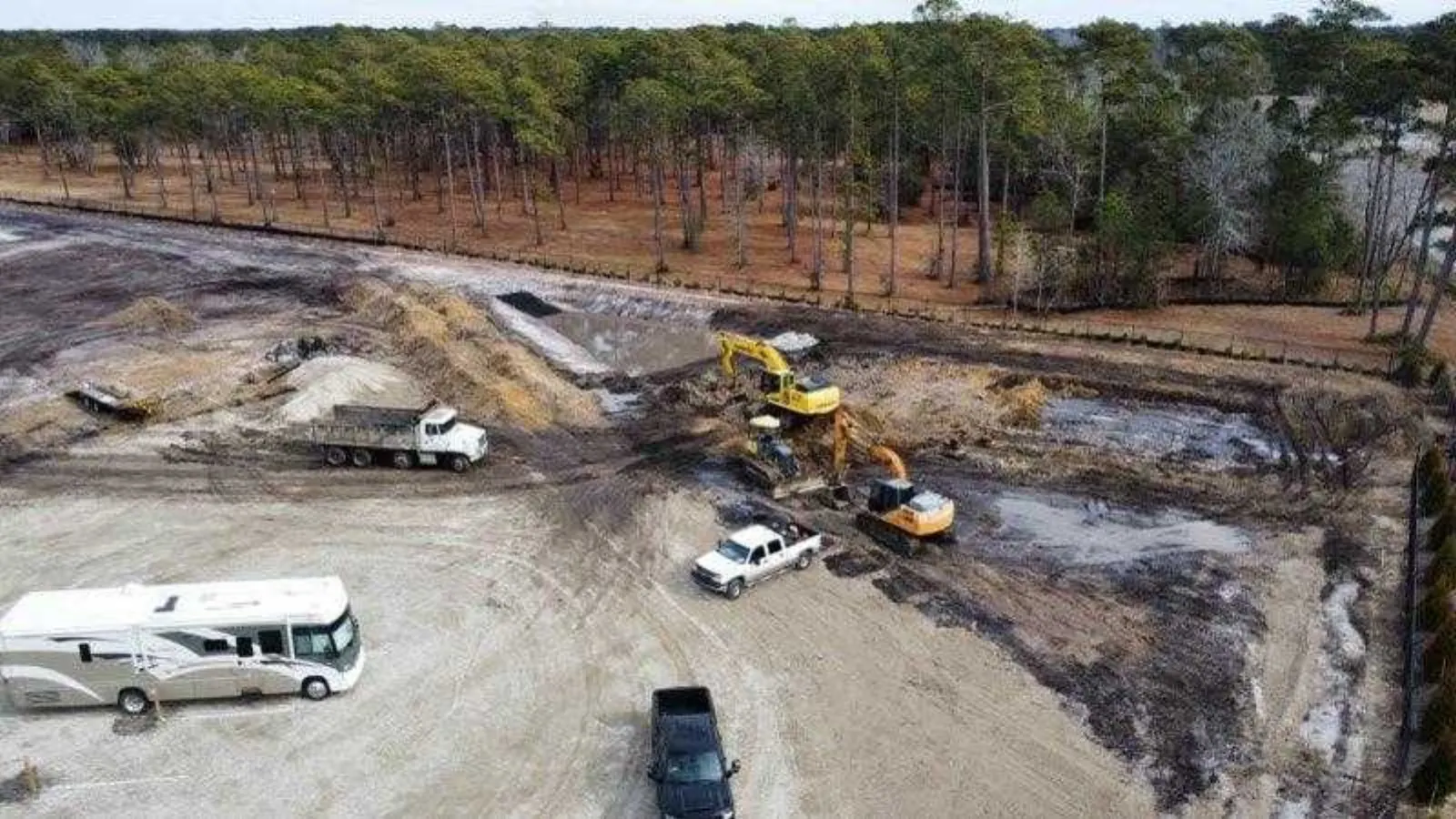
We clear land across Pender, New Hanover, Onslow and Columbus counties out of Burgaw. We have been at it since 2013. Work ranges from forestry mulching on overgrown acreage to full land clearing with an excavator and a tracked skid steer. Digging, hauling and shaping fall under excavation.
Permits stay in the property owner’s name. We can describe the site and the work involved, which is usually what the permit office asks about.
Call (910) 512-9578 for a free estimate. Tell us the acreage and the county, and we will come look at the site.