
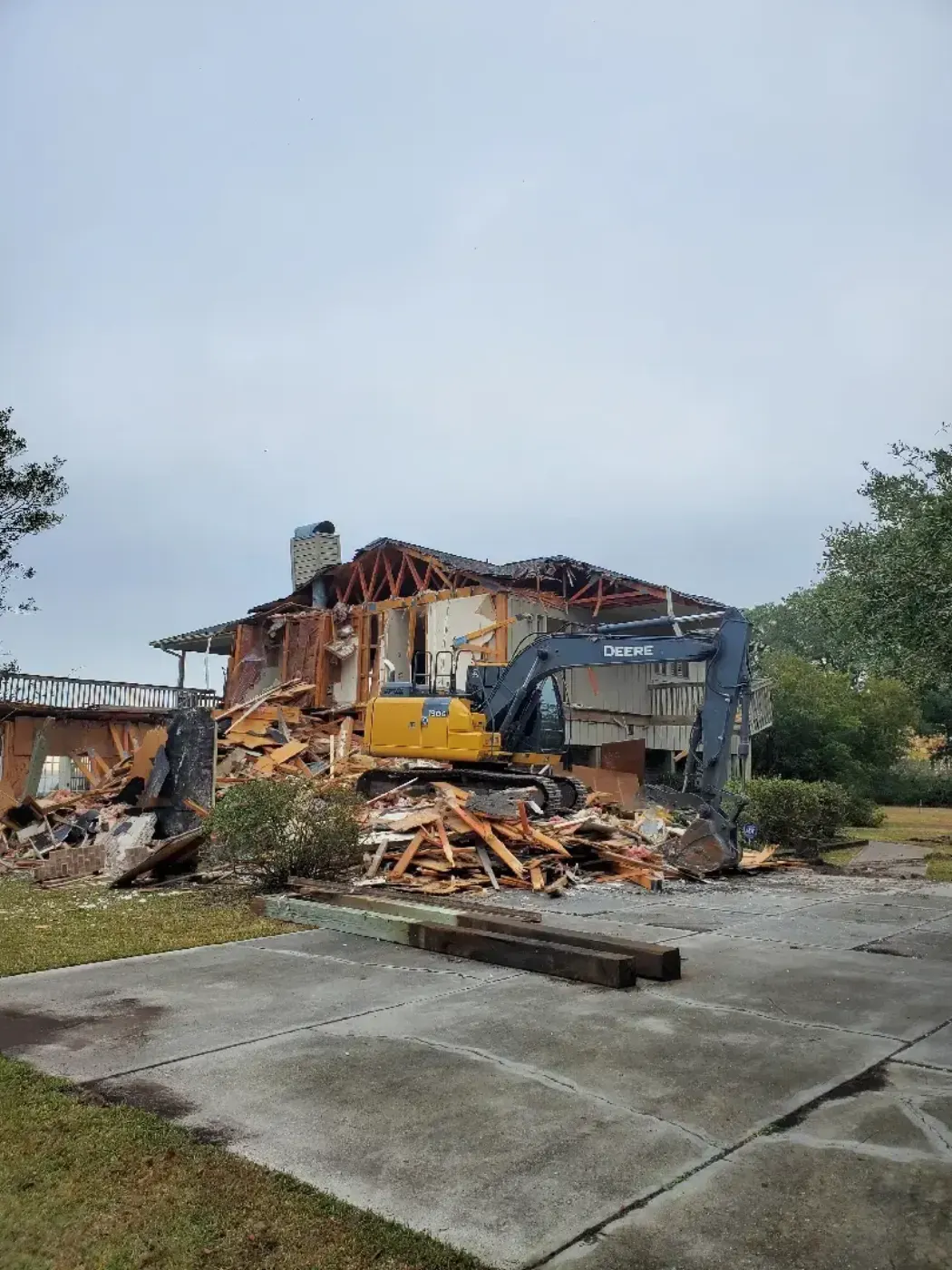
How Much Does It Cost to Demolish a House in North Carolina?
Published cost guides put a full house teardown between roughly $3,000 and $25,000. Most single family homes land somewhere in the $7,500 to $18,000 range. Mobile homes come in lower, around $3,000 to $8,000.
Those are national market figures from cost guides. Your own number depends on the size of the structure and what it sits on. Asbestos results and the haul distance move it too.
The gap between the low and the high end is mostly asbestos, foundation type and haul distance. North Carolina also adds a state notification step that catches people off guard.
What does a teardown cost by size and type?
| Structure | Reported cost range |
|---|---|
| Single wide mobile home | $3,000 to $5,000 |
| Double wide mobile home | $5,000 to $8,000 |
| House around 1,000 square feet | $5,000 to $10,000 |
| House around 1,500 square feet | $7,500 to $15,000 |
| House around 2,000 square feet | $8,000 to $30,000 |
| House around 3,000 square feet | $12,000 to $45,000 |
| Any size, priced by the foot | $2 to $17 per square foot |
The spread widens on the larger homes because different guides price them differently. Read the low end as a clean slab teardown with easy access. Read the high end as a job with asbestos, a deep foundation or a tight site.
What actually drives the price?
The asbestos survey. North Carolina requires an accredited asbestos professional to inspect a building before demolition begins. Cost guides put a basic inspection near $500. Where material has to come out, those guides report removal averaging about $2,000. A house full of it runs $10 to $30 per square foot.
Permits. Cost guides list demolition permit fees between $50 and $250. The fee is the small part. The calendar time in front of it is the real cost.
What the house sits on. A slab is the cheapest to break out and haul. A crawlspace adds block walls and footings. Reported foundation and basement removal runs from $1,000 up past $25,000. Most houses around here sit on a slab or a crawlspace, so this line usually stays on the low side.
Haul off. This is the line people underestimate. Guides report debris removal at $300 to $2,000, and $400 to $800 per truckload once the loads add up. Every load carries a tipping fee at the landfill.
Septic and utilities. Utilities get cut and confirmed before anything comes down. That means power and water, plus gas if the house has it. A septic tank gets pumped and then removed or capped, with reported tank demolition around $200 to $1,000.
Access. A house on an open lot is a simple job. A house tight to a property line or close to a well takes longer. So does one behind soft ground or wedged in among mature trees.
Salvage. Metal has value. Guides report mobile homes in decent shape carrying $400 to $1,000 in scrap. That offsets part of the bill.
What does North Carolina require before a house comes down?
There are two separate approvals. One is local. One comes from the state.
The local one is your permit. County and city building inspections offices issue it and set the inspections that follow. In Pender County, applications go through the county’s online PORT portal. Filing on paper instead adds a $25 processing fee.
The state one is the asbestos side. The state health department runs a Health Hazards Control Unit. It has to be notified of a building demolition, even when no asbestos is found. The notification is due at least 10 working days before work begins. Working days run Monday through Friday.
The state counts a residence as a single family dwelling or a multifamily building under 10 units. Owner occupied homes get the asbestos removal permit fee waived, though the rules still apply.
Forms and fees change over time. Confirm the current requirements with your county office before you set a start date.
What does the process look like start to finish?
- Site visit and quote. We look at the structure, the access, the utilities and what sits around it.
- Asbestos inspection by an accredited professional.
- Permit application and the state notification. The 10 working day clock starts here.
- Utility disconnects, with written confirmation from the providers.
- Teardown. The machine work is the fast part.
- Load out and haul to the landfill.
- Slab, footings and foundation walls out of the ground.
- Backfill, rough grade and site cleanup.
Published guides describe the teardown running from a few hours on a small structure. A large one can take several days. The front end is what stretches the calendar. Count the inspection, the notification window, the permit and the utility disconnects. Plan on a few weeks from first call to bare lot.
What is different about a mobile home?
Mobile homes are their own job and usually the cheaper one. Reported costs run about $3,000 to $8,000, or roughly $4 to $8 per square foot. Single wides sit at the low end.
The structure itself comes apart quickly. Most of the cost sits in the setup and the disposal.
Steel frame, axles, aluminum siding and copper wiring all carry scrap value, which can pull the number down. Older units are where asbestos is more likely to turn up, and that pushes it back up.
Disposal is the swing factor. A mobile home makes a lot of mixed debris, and where it can legally go varies by county.
What should be in the quote before you sign?
Ask where the work stops. Some quotes end at the structure. That leaves the slab, the footings, the block walls and any piers in the ground.
Get the disposal spelled out. Loads and tipping fees are the biggest variable in any teardown number, and you want to know who pays them.
Confirm who pulls the permit and who files the state notification. On most jobs that belongs to the contractor, and it should say so in writing.
Ask what the lot looks like when the machines leave. Backfilled and rough graded is a very different finish than an open hole.
Rural lots add their own line items. Older properties out here often carry a septic tank and a private well. Both need handling before or during the teardown.
What happens to the lot after the house is gone?
This is the part people forget to budget. A cleared house leaves a hole where the foundation was, plus disturbed dirt around the footprint.
Filling and compacting that hole is excavation work. Shaping the lot back into a usable, draining surface is grading and dirt work.
On sandy coastal soil a poorly filled foundation hole shows up as a low spot the first wet spring. Water pools there, and it stays soft long after the rest of the lot dries out.
Say a new build is going on the same lot. Handling the fill and the grade on the same trip beats paying to bring machines back.
Ready to get a number for your property?
Every teardown prices differently, and no cost guide can see your lot. Four things set your number. The size of the structure, the foundation under it, the asbestos results and the haul distance.
We are owner operated out of Burgaw and have been doing this work since 2013. We handle demolition across Pender, New Hanover, Onslow and Columbus counties.
Estimates are free. Call or text (910) 512-9578 with the address and what is coming down. Or send the details through our contact page. We will come look at it and give you a real number.