
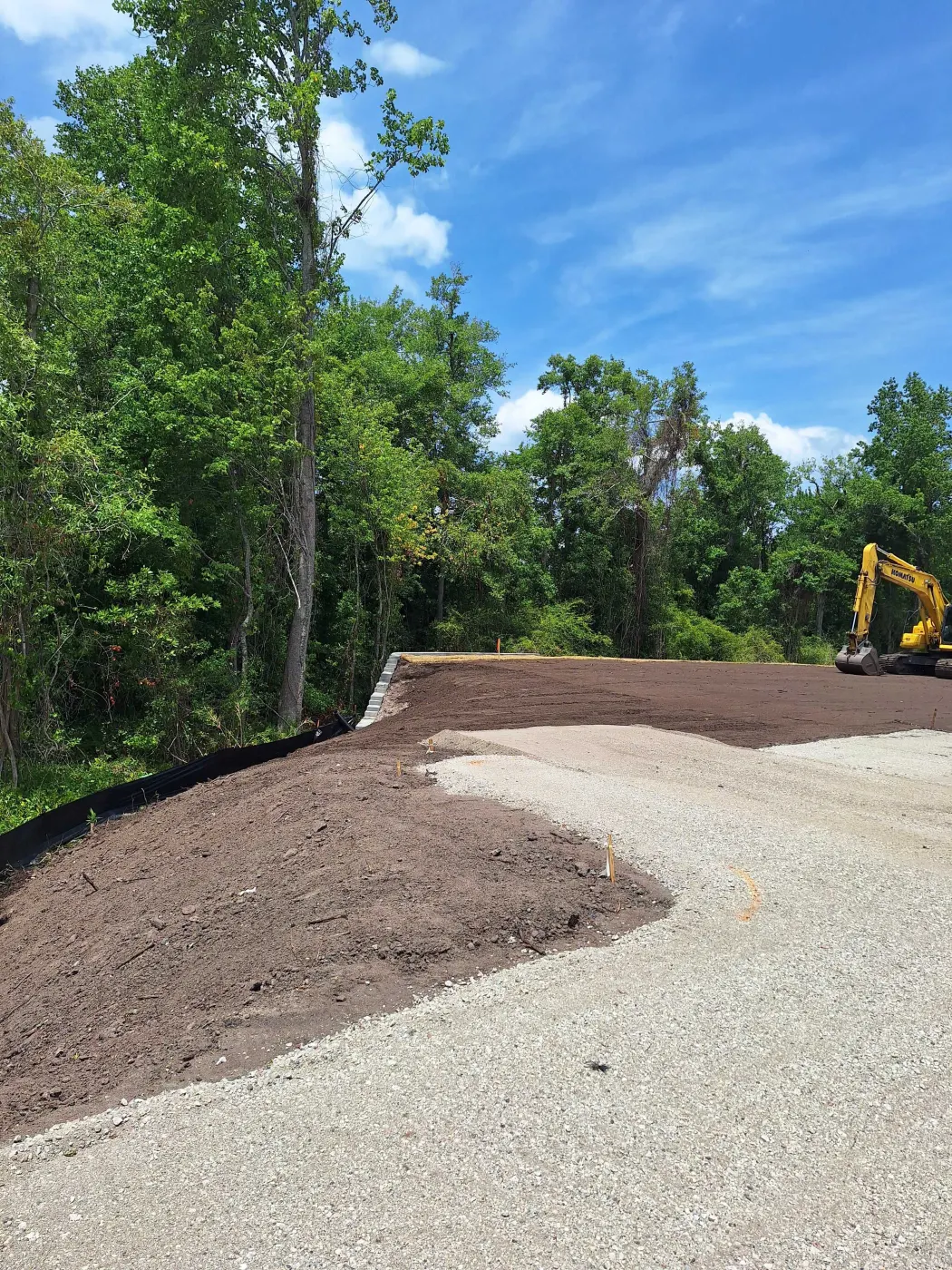
How Much Does a Gravel Driveway Cost in North Carolina?
A gravel driveway in North Carolina usually runs about $1 to $3 per square foot installed. Published national cost data puts a typical residential job at $600 to $1,800, with an average near $1,500. Long rural drives cost more, because you pay by the foot.
Those are market ranges. Your own number comes from your own lot. Length, width, base depth and haul distance set it.
What does a gravel driveway cost per linear foot?
Most home drives get built 10 to 12 feet wide. At 12 feet wide, $1 to $3 per square foot works out to about $12 to $36 per linear foot.
Here is how that math lands on common lengths, at 12 feet wide.
| Driveway length | Square feet | Market range |
|---|---|---|
| 50 feet | 600 | $600 to $1,800 |
| 100 feet | 1,200 | $1,200 to $3,600 |
| 200 feet | 2,400 | $2,400 to $7,200 |
| 400 feet | 4,800 | $4,800 to $14,400 |
Those ranges come from published national cost guides. Coastal counties often sit toward the top of the range. Soft ground needs more work under the stone, and more work costs more.
What does the stone cost by the load?
Stone is sold by the ton and hauled by the truckload. Published price ranges run like this:
- Base gravel #3: about $15 to $25 per ton
- Item #4 base stone: about $12 to $22 per ton
- Crushed granite: about $25 to $50 per ton
- Crushed stone: about $55 per cubic yard, or $65 per ton
- Delivery: about $50 to $100 per trip
Haul distance moves the load price more than the rock itself does. A quarry an hour out adds fuel and truck time to every load.
That is why two bids on the same driveway can look so different. One may cover four loads. The other may cover eight.
What layers make a driveway last?
A driveway is a small road. Roads work because of what sits underneath the surface.
We build in this order.
1. Strip the topsoil. Sod and roots come off the driving path. Stone laid over soft organic dirt sinks straight into it.
2. Shape the subgrade. The dirt below gets cut to grade and packed down. The surface gets crowned or sloped so water runs off instead of sitting.
3. Lay geotextile fabric. The fabric goes between the dirt and the stone. It keeps the two from mixing, so your base stays base.
4. Build the base. This layer is ABC stone, short for aggregate base course. It is crushed rock with fines mixed through, so it locks together and packs hard.
5. Compact it. Road base gets rolled to at least 95 percent of its tested density. A driveway built the same way holds its shape far longer than a dumped pile.
6. Top it off. A surface layer of stone goes over the packed base.
Skip steps three and four and you get a stone path that ruts by spring. It looks fine the day it is finished. It looks very different after one wet winter.
How wide and how thick should it be?
Ten feet is enough for a single car to pass. Twelve feet gives room for a truck and trailer without dragging tires off the edge. A turnaround or a parking pad adds square footage, so it adds cost.
Depth is the part people cut to save money. A drive that only sees cars can get by with less base than one that sees dump trucks. Firm ground needs less. Wet sandy ground needs more.
Every extra inch of base across a 200 foot drive is a lot of tonnage. That is the real reason two quotes on the same driveway can be so far apart.
Why does sandy coastal ground need a real base?
Southeastern North Carolina sits on the coastal plain. Soils here are sandy. Pine flatwoods hold water, and low spots can sit on a high water table.
Wet sand does not carry weight. Dump stone onto it and the stone works its way down. A year later you have ruts, and the rock you paid for is six inches under the surface.
Fabric and a packed base solve that. The fabric stops stone from migrating into the soil. The base spreads a truck’s weight over a wider footprint, so the soft ground never feels the full load.
Water control matters as much as rock. Good grading and dirt work gets rain off the surface and away from the driving path.
Do you need a culvert at the road?
If your driveway crosses a roadside ditch, the water still has to get past. A culvert pipe carries it under the drive.
Leave the pipe out and you dam the ditch. Water backs up, and the first hard rain cuts the crossing apart.
North Carolina law covers the road side of this. NC General Statute 136-93 requires a written permit from the Department of Transportation. That permit covers placing a structure in a state road right of way. It also covers digging up a state road to lay pipe. The statute says the work happens under the Department’s supervision and to its satisfaction.
Pipe size depends on how much water the ditch carries and how far the crossing spans. That gets figured on site.
How often does a gravel driveway need regrading?
Gravel moves. Tires throw it to the edges. Rain pushes it downhill and flattens the crown.
Regrading pulls that stone back into the driving path and re-cuts the shape. Published cost data puts grading work at roughly $100 to $3,400, and resloping a surface at $400 to $5,000.
A regrade costs a fraction of a rebuild. Doing it before the potholes get deep is what keeps the number small.
How often you need it comes down to traffic and how well the drive sheds water. A drive that drains clean holds its shape much longer than one that ponds.
What else moves the price?
Length and width set the starting number. After that, a handful of things push it up or down:
- Access. Wet or wooded lots slow the trucks down.
- Clearing. A new drive through woods needs trees and stumps out first. That is excavation work before any stone arrives.
- Base depth. Softer ground needs more base, and more base means more loads.
- Haul distance from the quarry.
- Culvert and ditch work at the road.
- Turnarounds and parking pads, which add square footage.
A bid built on stone alone usually means the base got left out. That is the cheapest driveway on paper and the priciest one over five years.
Does a gravel driveway work for a new build?
Yes, and it usually goes in early. Concrete trucks, lumber deliveries, equipment floats and dumpster trucks all need a firm path to the house site.
On a raw lot, the drive gets cut during land clearing. Base stone goes down before the heavy trucks start rolling. The top layer often waits until construction traffic is done, so the finish stone stays clean.
Get a price on your driveway
We are owner operated out of Burgaw and have been running machines since 2013. The person who answers the phone is the person running the excavator.
We build driveways across Pender, New Hanover, Onslow and Columbus counties. Call (910) 512-9578 for a free estimate, or send the details through our contact page. Tell us the rough length and the width you want. Say whether the drive ties into a state road.