
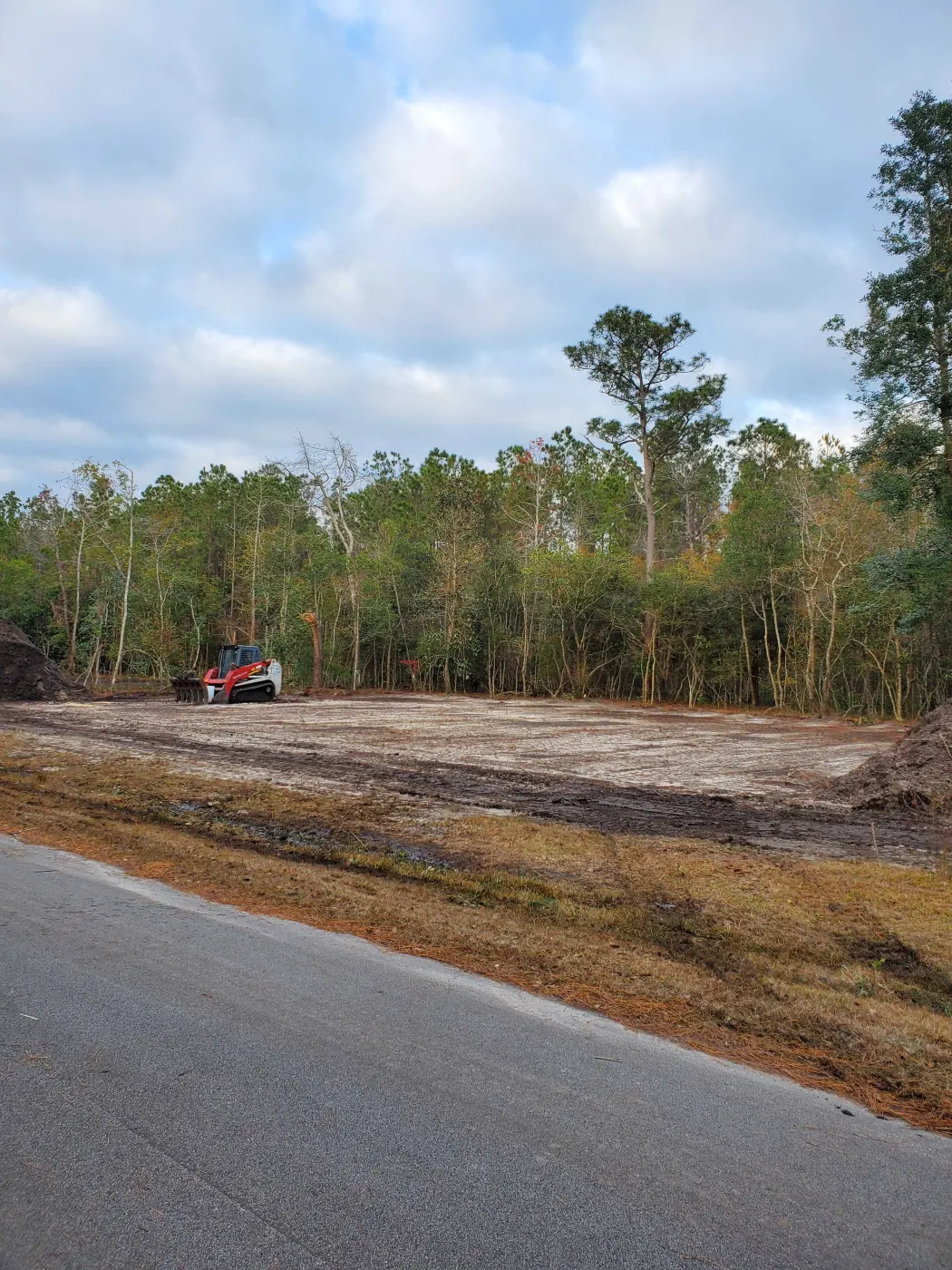
Clearing Land to Build a House in NC: What Happens First?
Site work on a wooded lot follows a set order. Clearing comes first, then the stumps come out. Next the ground gets rough graded. Then the building pad goes in as compacted layers. Driveway access usually gets cut early, so concrete trucks can reach the house site.
Every step depends on the one before it. Get the order wrong and you pay to move the same dirt twice.
What happens first on a wooded lot?
Before a machine touches the lot, the boundaries and the house location get marked. A surveyor sets the corners. Your builder or designer stakes out where the house sits.
Then the clearing footprint gets flagged. Most owners clear the house pad and the driveway path. They also clear room to work on all sides. Add space for a well and septic if the lot needs them. Leaving the rest of the woods standing keeps the lot private and cuts the bill.
Land clearing itself is plain machine work. Trees come down and get separated from the brush. Then the surface gets scraped clean of roots and soft topsoil. Anything organic left under a house becomes a settling problem later.
Do the stumps have to come out?
Yes, anywhere the house or the driveway will sit. A stump left in the ground rots. When it rots it leaves a void, and the ground above it drops.
There are two ways to handle them. Grinding chews the stump below grade and leaves chips behind. Full removal pulls the root ball out with an excavator and leaves a hole to backfill.
Under a building pad, removal wins. Grinding is the better call for stumps out in a yard or field, where nothing structural goes on top. Our stump grinding page covers that side of it.
Published cost data puts stump removal near $345 per stump on average. On a wooded lot that adds up, because there can be dozens.
What is a building pad and how is it built?
The pad is the firm, flat area the house sits on. It gets built up, and it gets compacted as it goes.
Fill dirt goes down in thin layers called lifts. Each lift gets compacted before the next one goes on top. Dumping four feet of dirt at once leaves the bottom loose. That is where settling starts.
On engineered work, compaction gets measured rather than eyeballed. Road base, for example, is rolled to at least 95 percent of its tested density. Your builder or engineer sets the target for a house pad.
The pad also needs to sit higher than the ground around it. Water has to run away from the house on every side. That is grading and dirt work, and it decides whether a crawlspace stays dry.
Why does the driveway go in before the house?
Concrete trucks are heavy. A loaded mixer can bog down in soft ground and sit there until a machine drags it out.
So the driveway path gets cut and based early. Base stone goes down before the first heavy delivery. The finish layer often waits until framing is done, so construction traffic does not chew it up.
Access is a real budget item on long rural drives. It also sets where trucks can turn around, which most people forget about until a mixer is stuck.
What does the builder need from the site?
Builders want a few things ready before they mobilize:
- A pad at the right elevation, compacted and cut to size
- Room around the pad for footing crews and a concrete pump if one is needed
- A drivable access road that holds a loaded truck
- Drainage that carries water away from the pad
- A staging area for materials and a spot for the dumpster
- Erosion control in place where the county or state requires it
That list is worth confirming with your builder before the machines leave the site. Moving dirt twice is the most avoidable cost on a build.
Does clearing land need a permit in North Carolina?
It depends on how much ground gets disturbed. NC General Statute 113A-57 sets the state rule. Any activity that will disturb more than one acre needs an erosion and sedimentation control plan. The plan gets filed with the agency having jurisdiction. It must be approved 30 or more days before the work starts.
The same statute sets a cover deadline. Slopes have to get temporary or permanent ground cover within 21 calendar days of completing any phase of grading.
County rules sit on top of the state rules. Pender County reviews zoning, floodplain development, site development plans and subdivisions through its planning department. Check there for your parcel before you schedule machine time.
How long does site work take?
A day count given before anyone sees the lot is a guess. Too much of the schedule sits outside anyone’s control.
What actually sets the pace:
- Lot size and how thick the timber is
- How wet the ground is the week we start
- Rain. Coastal North Carolina gets plenty, and a soaked lot stops dirt work cold
- How much fill has to be hauled in or shifted around
- Permit review time, which runs on the county’s clock
- Where the water table sits in the low spots
We give you a window once we see the lot and know the scope. If weather pushes the dates, you hear about it while it is happening.
What does clearing a lot cost?
Published national cost data gives a working range. General clearing runs about $250 to $1,000 per acre. Tree density drives the number hard.
| Lot type | Cost per acre |
|---|---|
| Lightly wooded | $500 to $2,000 |
| Heavily wooded | $3,000 to $5,600 |
The same cost data lists other site items:
- Forestry mulching: about $400 to $600 per acre
- Grading and leveling: about $500 to $7,700
- Excavation work: about $1,500 to $5,100
- Land survey: around $500
- Building permits: about $400 to $2,300
Those are market ranges from national guides. A real number comes from the lot itself. Timber density, haul distance for the debris, ground conditions and access all move it.
What order does the whole job run in?
On a typical wooded lot, the sequence looks like this:
- Survey and staking, so everyone works off the same lines
- Erosion control installed where it is required
- Clearing the flagged footprint
- Stumps and root balls out of the pad and drive
- Rough grading to shape the site and set drainage
- Driveway cut and based, so trucks can get in
- Pad built up in compacted lifts to the builder’s elevation
- Final trim grade around the pad before footings
Utilities, wells and septic get scheduled into that order by your builder. Some of it overlaps. The parts that cannot overlap are the ones that cost money when they get flipped.
Ready to start on your lot?
We are owner operated out of Burgaw and have been clearing land and moving dirt since 2013. The person who answers the phone is the person running the excavator.
We work across Pender, New Hanover, Onslow and Columbus counties. If your lot is still woods, clearing and excavation usually happen in the same trip out.
Call (910) 512-9578 for a free estimate. Have your survey and your builder’s pad elevation handy if you already have them.